
Legs tapping off the miles, left and right, through the hills, over the river and through the woods, all of that concern about life, universe and everything is focused on making it through and enjoying it. Enjoying the moments of flashing progress that we lock in for, that caring allows us to dig into.
Not focusing on the technology to keep track of it all. Not focusing on the trust of the satellites that keep us dialed in spin a thousand times a moment. We then can look at the map later in awe and wonder, save for what we saw and avoid blunders.
Technology catches everything, the watch catches everything.
Unless I forget to tap the start button and it is miles to nowhere without a care. No route, no clout. An hour of miles and smiles that happened at no particular place, at no particular pace.
That map haunts me, it was a good run, I saw a dog waiting to cross a street, I can recall that patience as well as I can recall the empty map. But that map stuck with me because I stare at the reporting version of that map all the live-long day.
Somehow, somewhere, in your analytics at this very moment, a bucket overflows with runs like that: real people, real visits, no map attached, maybe a dog smiling on the street.
The bucket that swallowed the signal
Direct traffic was once a kudos, a compliment, a signifier of a memorable URL in the world of infinite webpages. Now Direct is where your analytics files every visit that is missing that je ne sais quoi of tracking technology. Errors, like mysteries of the universe, keep compounding and that pile keeps getting taller.
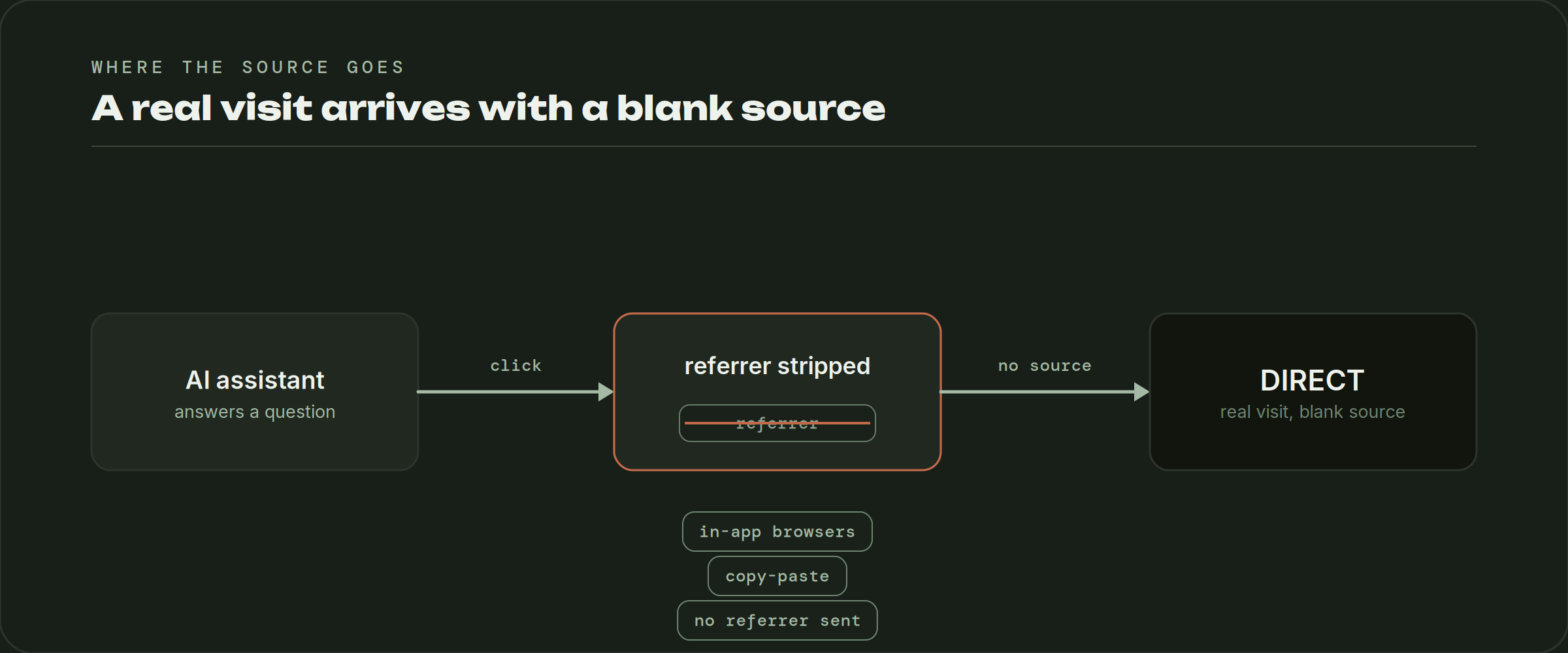
AI isn’t mischievous enough (yet?) to throw a spanner in the works and prevent GPS on a run, but by function, it will not pass over that referrer information. The visit is real, the travel happened, but the attribution that the reporting was built on just did not get the data it was hoping for. So alas, it gets filed under Direct and moves on.
Pew Research put numbers on it in July 2025. They metered the real browsing behavior of 900 US adults across 68,879 searches. When Google showed an AI answer, 8% of searches ended with a click on a traditional result, versus 15% when no answer appeared. Clicks on links inside the AI answer itself: 1%. Clicks are drying up.
And the visits that do arrive come from tools growing fast. Similarweb estimated 1.13 billion AI referral visits to the world’s top 1,000 sites in June 2025, up 357% year over year. Similarweb calls that number an estimate, and so should you. Meanwhile Cloudflare’s network data put automated traffic at 57.5% of all web requests in 2025, humans at 42.5%. Imperva measured a separate network a separate way and landed above 53%. Two networks that do not talk to each other arrived pointing the same direction.
The web is a running trail devoid of humans, most of the web’s requests are no longer people. But without updating your reports, you may still assume there are people out there.
What you can still see
Start somewhere, start where the signal still exists.
Google quietly began grouping some AI sources into their own channel and it just misses left and right with the confidence of someone guessing their own pace running through the woods.
Homework time!
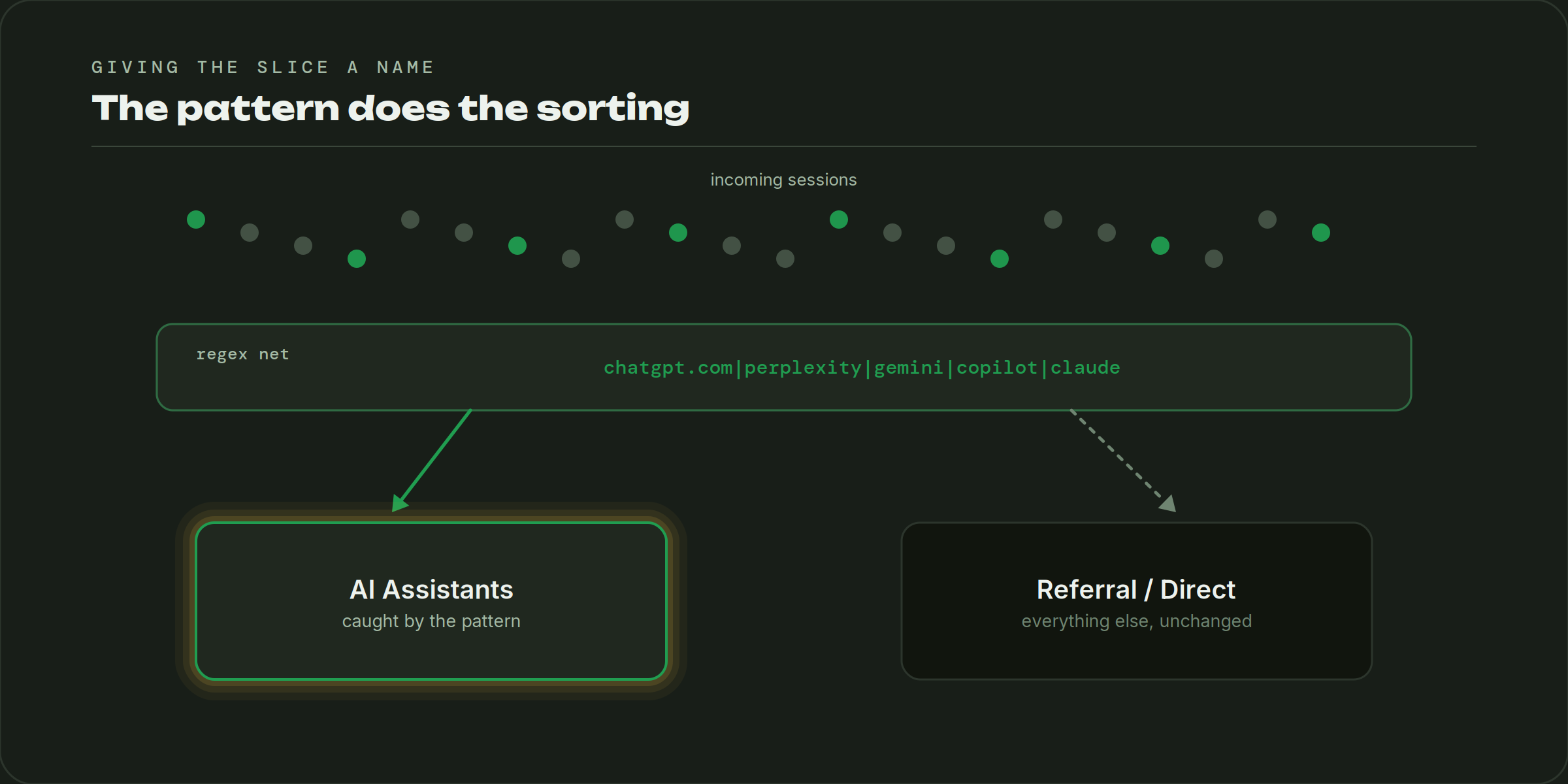
Build a custom channel group instead: one channel where session source matches a regex along the lines of chatgpt.com|perplexity|gemini|copilot|claude. Suddenly the AI slice of your traffic has a name instead of hiding inside Referral and Direct. The number will be smaller than the truth. It will still change the conversation, give you a little something something.
Like all sunny afternoons, take the gifts when they come with the changing times. ChatGPT now appends utm_source=chatgpt.com to many of the links it sends out. When you see that parameter, believe it. Most assistants send nothing at all, which makes the ones that do worth trusting.
The part you control
Which brings me to the boring hero of everything I write about measurement.
The tag you set by hand is the last signal you fully control.
Cookies bake away in shrunk unset morsels behind consent screens and browser defaults. Platform auto-tagging hands you a label and a black box of math you are to trust. The referrer gets stripped somewhere along the road and never arrives.
The UTM survives all of it, because it lives inside a URL you placed yourself.
Tag every link you place. Your emails. Your social posts. Your syndication. The links your sales team sends in follow-ups.
Automate the persistence. Capture it in a hidden field on the form and write it to the contact record. Then just report pipeline by campaign in the CRM.
Why bother, when the visible slice is this thin?
Because it is something, because that sliver of a slice, it converts. Ahrefs studied their own product-led site in 2025 and found AI search visitors converting at 23x the rate of traditional organic. Before that number lands in a board deck, remember where it came from: one company measuring its own site in one vertical.
But if even a fraction of that ratio holds for you, the channel you can barely see may already outperform the ones you report on every week.
What you cannot tag
More miles, more miles, now for the harder part.
You can only tag links you place. When someone asks an assistant about your category, reads the answer and shows up three days later by typing your name into the bar, there is nothing to click and nothing to tag. No dream it seems.
A real chunk of AI influence cannot be tagged at all, and anyone quoting you a precise AI attribution figure is dreaming with the clouds in the sky.
You are not going to get a complete number. Aim for a smaller set you actually trust, sitting next to an honest label that says the rest is dark.
Bots already make most of the web’s requests, and the next wave will be bots acting as a buyer, doing the buying for them. To your bot filter, a purchasing agent looks like every other bot. Go read what your filters exclude before they turn away a customer who happens to be a script.
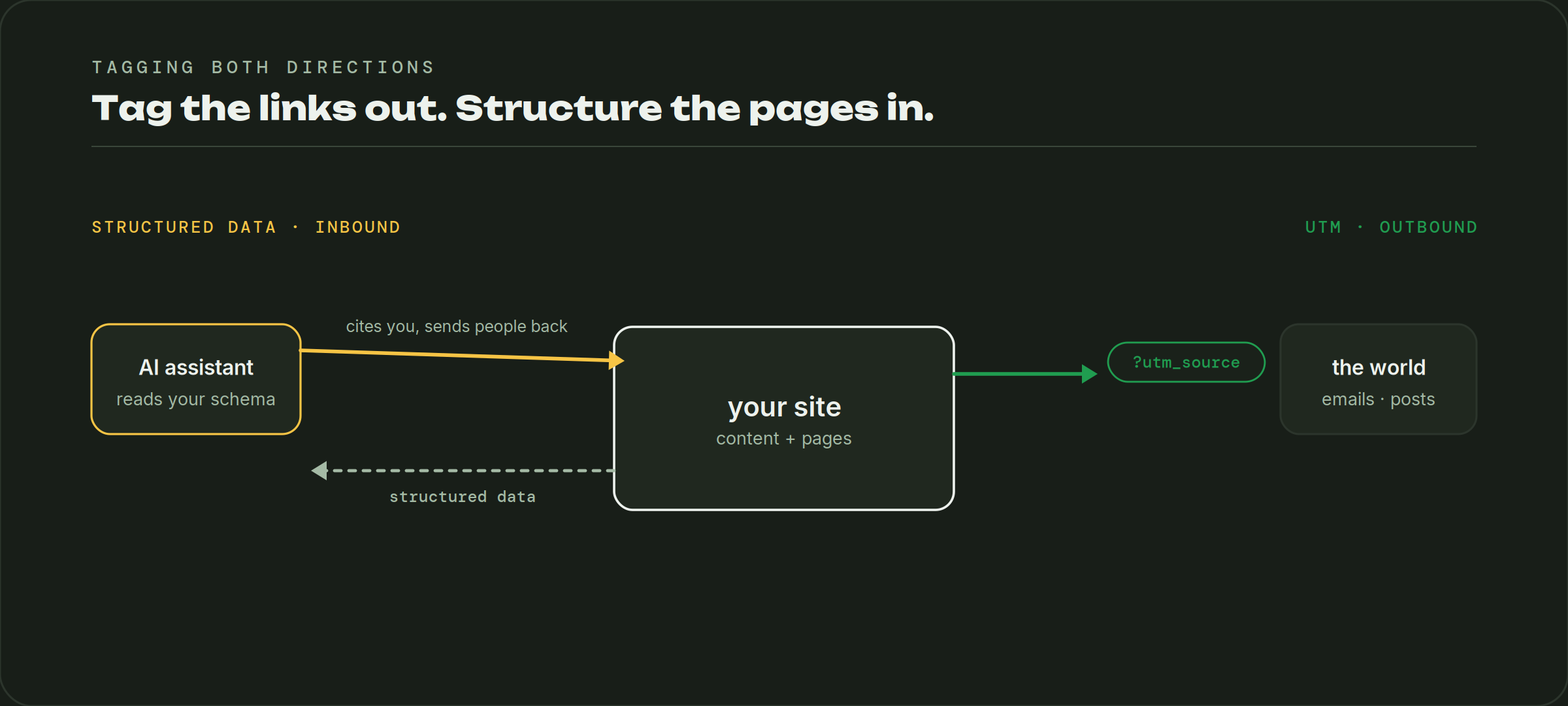
Tagging runs both directions now, too. UTMs mark the links you send out into the world. Structured data marks the content coming in, so an assistant can read your pages cleanly, cite you and send people back.
The things tech cannot write
Take the wins where you can get them. Start the reporting while risks and tides are low. Perfection will remain elusive and things will change, but seeing patterns is at least understanding the game. A few quick reports of the horizon let’s you know of the incoming storms or outgoing waves.
Back to that dog at the start, back to the pup crossing the road. I manually put in the miles anyways, took a guess, something to look back on, I let inspiration strike, so in awe and wonder of this patient dog, trusting in the process of automated street crossing. The manual process and moment of inspiration gave the gift of a haiku:
A dog watches on
Wait, wait to cross main st, wait
A dog waits to run