

You know where the olive oil is.
Not because you looked. Because you put it there, and your hand just knows. Same with the bread knife. Same with that spice mix you built on a Sunday afternoon when you had an hour and good music and decided to get it right once so you’d never have to think about it again. You walk into your kitchen and the whole thing is already on your side. Already mid-sentence. The jazz is on, the light is doing that early evening thing where it hits the counter just right, and you’re not cooking from zero.
You’re cooking from everything you’ve already figured out.
Now open a new AI chat and tell me how that feels.
You’re explaining yourself again. Who you are, what you do, who you’re talking to, how you like to write, what matters, what doesn’t, what “good” actually looks like in your work. And the tool is nodding along, helpful, capable, ready. It just doesn’t know you. It never did. Close the tab and it’s gone. Open a new one tomorrow and you’re a stranger again.
Every session. From scratch. You’re the only one carrying anything forward.
That’s not a prompting problem.
That’s a kitchen problem.
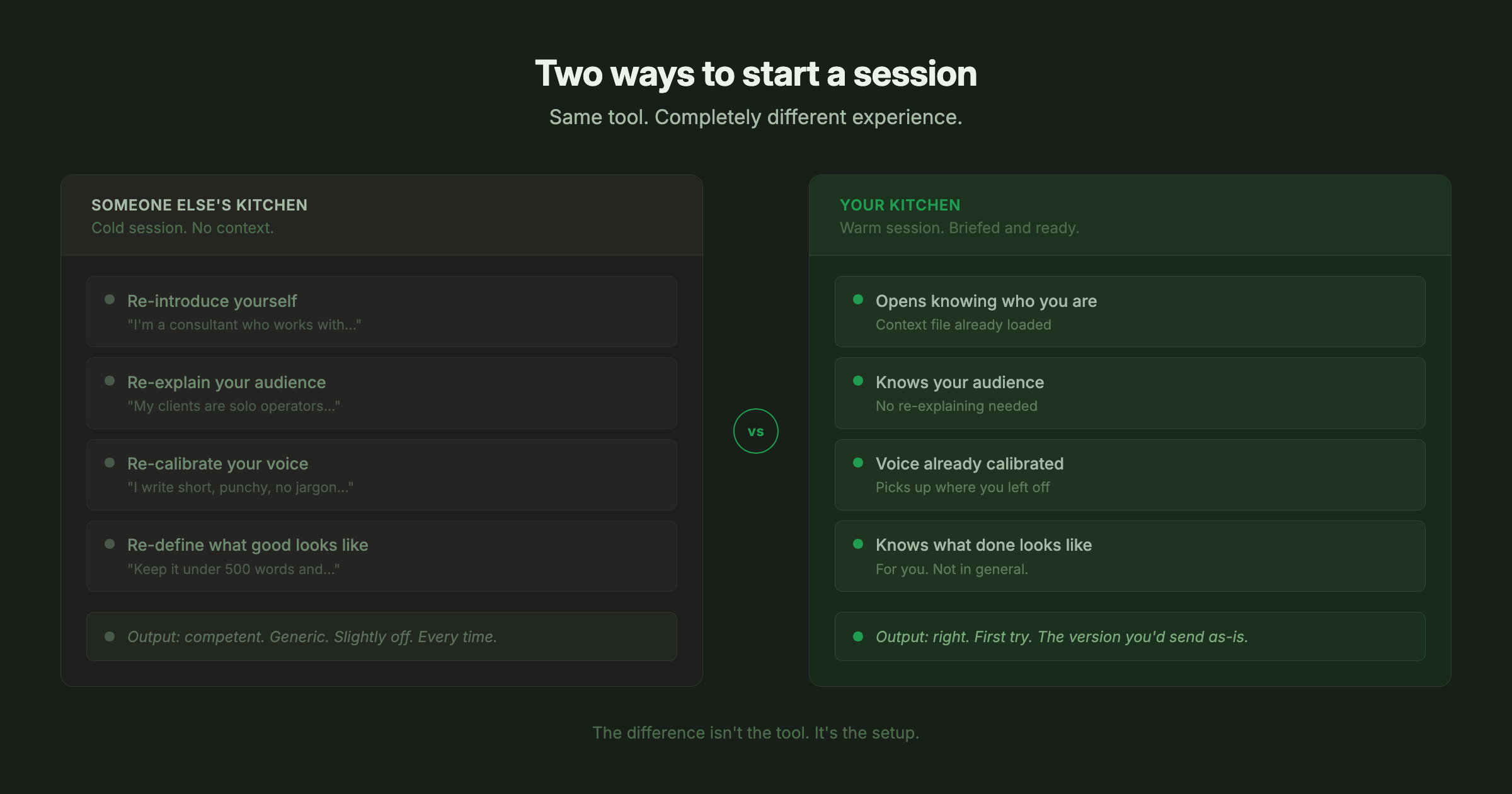
Most people try to fix this by writing better prompts. Sharper instructions, more detail, a tighter structure. It helps. For that session. Then tomorrow you do it again, same re-introduction, same context from scratch, same ten minutes getting the tool up to speed on who you are before you can get to the actual work.
You’re sharpening a knife that goes dull overnight because you’re sharpening the wrong thing.
What compounds is context. The stuff you tell the tool once and never repeat again. Here’s who I am and what I’m building. Here’s how I talk and what I care about. Here’s what done looks like from where I sit. Here’s the spice mix. Once that exists, you stop re-explaining and start working. The session opens already knowing you. Not performing helpfulness in the general direction of a stranger. Actually knowing you.
That’s the difference between a kitchen that’s yours and one you borrowed for the weekend.
Here’s what people get wrong about building it: they imagine something elaborate. A perfectly engineered document that takes a weekend and a system to maintain. Something that requires a consultant.
It’s simpler than that. Think about what you find yourself re-explaining at the start of every session. That one piece of context that, without it, everything comes back slightly wrong. That’s your olive oil. That’s where it goes in the jar, labeled, ready.
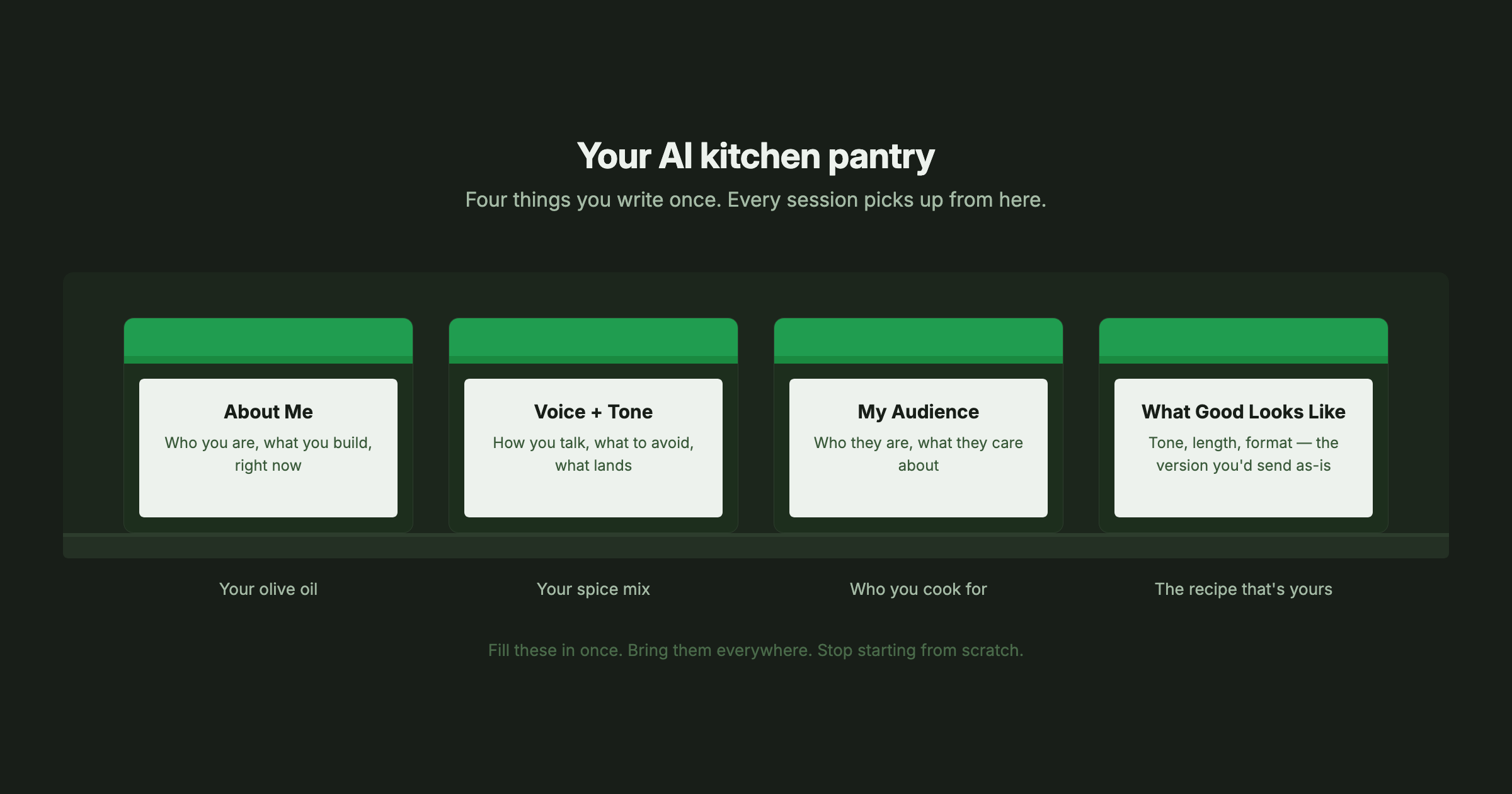
For most people it comes down to a handful of things. Who you actually are professionally, not the LinkedIn version, the working version. How you communicate and what your voice sounds like when it’s landing right. Who your audience is and what they’re paying attention to. What good means in your specific context, not in general, in yours.
Write it down. Put it somewhere portable. And the next time you open a chat anywhere, any tool, any device, even someone else’s setup, you bring your knives.
There’s a specific feeling the first time a session actually knows you.
You type something half-formed. The kind of thought you’d only say out loud to someone who already gets it. And it comes back right. Not close. Not in the right neighborhood. Right. The voice is there. The priorities are there. The thing you didn’t say but would have wanted is already in the room.
That’s what setup feels like when it’s working.
And once you feel it you can’t go back. A cold session after that, re-explaining yourself, starting from zero, watching the tool nod along while it figures out who you are, feels like cooking in someone else’s kitchen after a year in your own. You know what’s missing. You know exactly which cabinet should have something it doesn’t.
You know where your olive oil should be.
Now go put it there.
The starter kit
Four fields. Paste this into a plain text file, fill it in once and bring it to every session. That’s it. That’s the whole system.
# About Me
Who you are professionally, in plain language. Not your title.
What you actually do, who you do it for and what you're trying
to build right now.

# How I Communicate
How you write and talk. Formal or casual. Short and punchy or
long and narrative. Anything you always want or always want to avoid.

# My Audience
Who you're usually talking to or writing for. What they care about.
What they're skeptical of. What makes them pay attention.

# What Good Looks Like
What a successful output actually looks like for you specifically.
Tone, length, format, feel. The version you'd send without editing.
Fill those in and you’ve got your kitchen. Save it somewhere you can paste it fast. A Notion page, a notes app, a file on your desktop. Doesn’t matter where. What matters is that it exists and you actually use it.
Your AI doesn’t know where the olive oil is yet.
This is where you tell it.